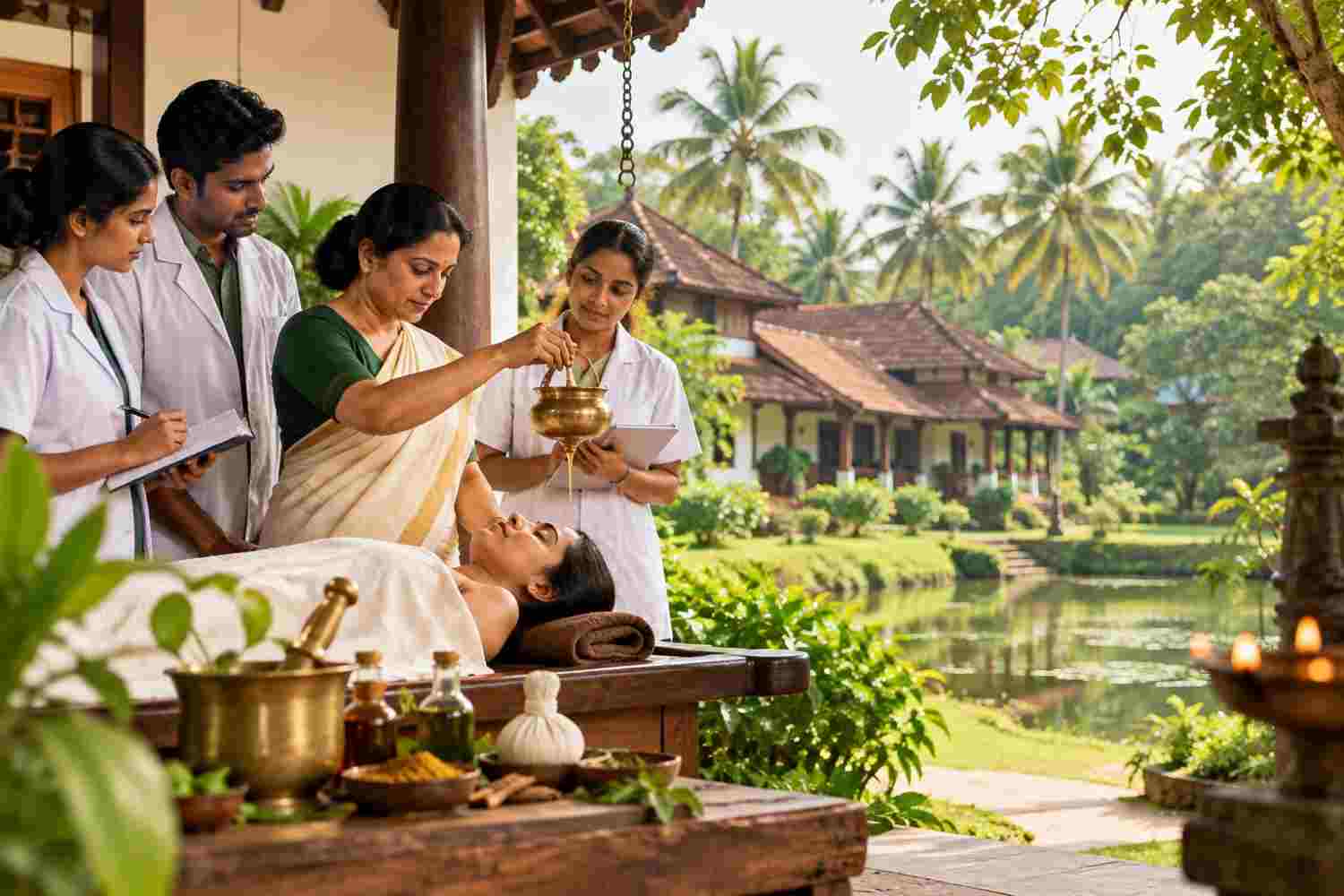
When people think about Ayurveda, Kerala is often one of the first places that comes to mind. Ayurveda is not simply a subject taught in classrooms here. It has been part of Kerala’s culture and everyday traditions for generations.
That is one of the reasons many students and Ayurveda enthusiasts look for an Ayurveda institute in Kerala. They want more than just theoretical knowledge. They want to understand how Ayurveda is traditionally practised, learn from experienced teachers, and get practical exposure in an environment where Ayurveda has deep roots.
But choosing an institute is not something you should rush into. The right course, training, faculty, practical exposure, and recognition can make a big difference to your learning experience.
Why Study Ayurveda in Kerala?
There is something different about learning Ayurveda in a place where the tradition is still closely connected to everyday life.
Across Kerala, you can find Ayurvedic hospitals, treatment centres, wellness resorts, traditional practitioners, herbal gardens, and educational institutions. This creates an environment where students can see how Ayurvedic knowledge is used beyond textbooks.
Kerala is also known for traditional approaches to Ayurvedic therapies, herbal preparations, diet, lifestyle, and wellness practices.
For a student, this can make the learning process more interesting. Instead of simply memorising concepts, there is an opportunity to understand the background and practical side of Ayurveda.
What Do You Learn at an Ayurveda Institute?
The subjects depend on the course you choose. A short-term programme will naturally be different from a professional degree programme.
However, students may be introduced to areas such as Ayurvedic principles, medicinal plants, traditional therapies, diet and lifestyle, basic anatomy and physiology, and practical procedures.
One of the interesting parts of learning Ayurveda is understanding the connection between different aspects of life.
Food, sleep, daily routines, seasons, physical activity, and mental wellbeing are all considered important within traditional Ayurvedic thinking.
Rather than looking at one aspect in isolation, Ayurveda traditionally takes a broader view of wellbeing.
Understanding the Basics of Ayurveda
Before learning advanced concepts, students need to understand the foundation of Ayurveda.
Concepts such as Dosha, Prakriti, Dhatu, Mala, Agni, and Dinacharya form an important part of Ayurvedic education.
At first, some of these terms may seem unfamiliar. With proper teaching and practical examples, however, students can gradually understand what they mean and how they are connected.
A good learning environment is especially helpful here because students can ask questions and discuss these concepts rather than simply learning definitions for an examination.
Learning About Ayurvedic Herbs
Herbs are closely associated with Ayurveda, and learning about them can be one of the most interesting parts of an Ayurveda course.
Students may learn to identify commonly used medicinal plants and understand their traditional uses, properties, and preparation methods.
Kerala's natural environment also makes the subject more engaging. Students can encounter many plants and herbs that are traditionally associated with Ayurvedic practices.
Of course, learning about a herb and using it as a treatment are two different things. Therapeutic use should always be based on appropriate professional knowledge and supervision.
Practical Learning Makes a Difference
Imagine learning about an Ayurvedic therapy from a textbook and then seeing how the procedure is actually demonstrated.
The difference can be significant.
Practical sessions can help students understand things that are difficult to learn from reading alone. Depending on the programme, this may include demonstrations of traditional procedures, preparation techniques, herbal identification, professional practices, or supervised clinical exposure.
For students planning a career related to Ayurveda, practical experience can also help them become more comfortable with the professional environment.
How Do You Choose the Right Ayurveda Institute in Kerala?
There are many options available, and every institute may have a different approach. So, instead of choosing a course only because of its name or location, spend some time checking what it actually offers.
Look at the Course
Start with the syllabus.
What will you learn? How long is the course? Are there practical sessions? Is there an internship or clinical exposure?
A clear course structure makes it easier to understand what you are actually signing up for.
Check the Faculty
Teachers have a major role in any educational programme.
Look at the experience and qualifications of the people teaching the course. Experienced practitioners can often explain traditional concepts using practical examples that make them easier to understand.
Ask About Practical Training
If you are interested in learning Ayurveda professionally, do not overlook practical training.
Ask the institute how much practical exposure students receive and where the training takes place.
Understand the Qualification
This is particularly important.
Not every Ayurveda course provides the same type of qualification. A short certificate programme and a recognised professional degree are not equivalent.
If your goal is professional practice, make sure you understand the qualification, recognition, and registration requirements before joining.
Compare Fees and Course Duration
Course fees can vary depending on the programme and institution.
Do not look at the fee alone. Compare the curriculum, practical training, faculty, facilities, duration, and qualification along with the cost.
Who Can Study Ayurveda?
There is no single answer because eligibility depends on the programme.
Someone interested in Ayurveda as a subject may choose a short-term certificate or introductory course. Students planning a professional career may need to meet specific academic requirements for recognised programmes.
Before applying, check the institute's official admission criteria.
This can save you from choosing a course that does not match your educational background or future plans.
Ayurveda Education and Career Opportunities
People choose Ayurveda courses for different reasons.
Some are interested in traditional healthcare and wellness. Others want to build a professional career. Some may already work in the wellness industry and want to improve their knowledge.
Depending on the qualification, career paths can include areas such as:
- Ayurvedic hospitals
- Wellness centres
- Ayurvedic resorts
- Research and education
- Ayurvedic medicine and product companies
- Wellness and lifestyle programmes
- Academic institutions
Professional practice, however, requires the appropriate recognised qualification and registration wherever applicable.
So, if your goal is to become an Ayurvedic professional, choose your educational path carefully rather than relying only on a short-term course.
Why Kerala Is an Interesting Place for Ayurveda Students
One of the biggest advantages of studying Ayurveda in Kerala is the environment itself.
You are learning in a state where Ayurveda has a visible presence.
Traditional treatment centres, Ayurvedic hospitals, wellness resorts, herbal gardens, and practitioners can be found across different parts of Kerala.
For students, this can provide a useful connection between what they learn in class and the wider world of Ayurveda.
It also gives learners an opportunity to understand how Ayurveda has evolved while still retaining many of its traditional practices.
Ayurveda for International Students
Kerala also attracts people from different countries who are interested in Ayurveda and wellness.
Some international learners may be interested in formal academic programmes, while others may prefer shorter courses, workshops, or introductory programmes.
If you are an international student, it is important to check more than just the course content.
Look at admission requirements, duration, language of instruction, accommodation, visa requirements, fees, and the recognition of the qualification.
A little research before joining can make the entire experience much easier.
Traditional Knowledge in a Modern Learning Environment
Ayurveda has a long history, but learning Ayurveda today does not have to mean relying only on traditional methods of teaching.
Many educational programmes combine classical Ayurvedic concepts with structured academic learning, practical demonstrations, research, documentation, and modern educational methods.
This can help students understand where Ayurvedic ideas come from while also developing the ability to study them in a structured way.
For someone genuinely interested in Ayurveda, this combination can make the learning experience more meaningful.
Is Studying Ayurveda in Kerala Right for You?
That depends on what you are looking for.
If you have always been interested in Ayurveda, want to understand traditional wellness practices, or are considering a professional path in this field, studying in Kerala can give you an opportunity to learn in a culturally relevant environment.
But take your time before choosing an institute.
Visit the institute if possible. Speak with the admission team. Ask about the faculty and practical training. Understand exactly what qualification you will receive.
Most importantly, be clear about what you want from the course.
Final Thoughts
Choosing an Ayurveda institute in Kerala is about more than finding a place to study. It is about finding an environment where you can understand Ayurveda properly, ask questions, gain practical exposure, and build knowledge step by step.
Kerala's long association with Ayurveda makes it a natural destination for people interested in learning this traditional system.
Whether you are a student beginning your educational journey, a wellness professional looking to expand your knowledge, or someone simply curious about Ayurveda, the right course can give you a strong foundation.
Take the time to compare institutes, understand the course structure, check the qualification, and look at the practical learning opportunities before making your decision.
When you choose an institute based on your actual learning and career goals, your Ayurveda education can become much more than something written on a certificate. It can become a deeper understanding of a tradition that has been part of Kerala for generations.
Frequently Asked Questions
Which is the best Ayurveda institute in Kerala?
The right institute depends on your course, educational background, career plans, budget, and the type of training you are looking for. Check the institute's curriculum, faculty, practical training, and qualification before choosing.
Why should I study Ayurveda in Kerala?
Kerala has a long association with Ayurveda and offers an environment where students can learn about traditional Ayurvedic practices alongside structured education.
What can I study at an Ayurveda institute?
Depending on the programme, you may study Ayurvedic principles, herbs, medicines, therapies, diet, lifestyle, anatomy, physiology, and practical procedures.
Are there short-term Ayurveda courses in Kerala?
Yes, institutes may offer different types of short-term courses and certificate programmes. Course duration and eligibility vary between institutions.
Can international students study Ayurveda in Kerala?
International students may be eligible for certain Ayurveda programmes depending on the institute and course. Admission, visa, qualification, and other requirements should be checked before applying.
Is practical training included in Ayurveda courses?
It depends on the programme. Some courses include demonstrations, practical sessions, internships, or supervised clinical exposure, while others are primarily theoretical.
What should I check before joining an Ayurveda institute?
Check the course syllabus, faculty, practical training, duration, fees, admission requirements, qualification, and recognition. If your goal is professional practice, also check the applicable registration requirements.